
Beatriz Milhazes, Além do Horizonte (Beyond the Horizon)
White Cube (London), Nov/19 – Jan/17
Just before closing for Christmas, White Cube presents an exhibition by the Brazilian artist Beatriz Milhazes. The show brings a vivid sense of the colours and rhythms associated with the southern hemisphere into a London winter that is otherwise characterised by low levels of light and energy.
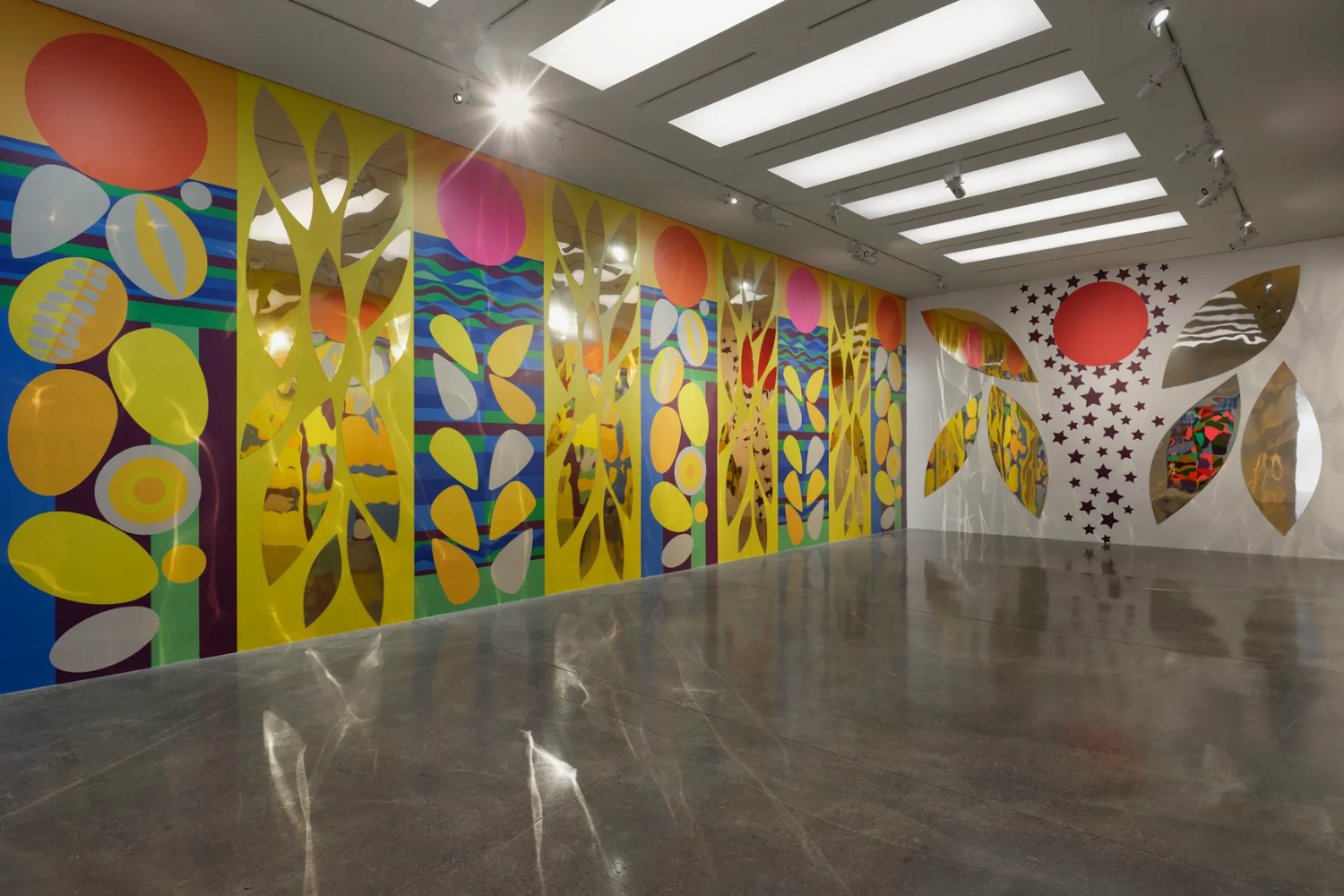
The exhibition begins with an immersive installation in which the walls are painted with stripes and punctuated by cut-out shapes. The room is filled with colour: yellow, orange, pink, blue, and green, arranged in patterns that recall flower petals, suns, and waves. The installation is overwhelming, yet the compositions are carefully structured and organised through repetitive geometric forms. Several elements are made of reflective material, which mirror fragments of the viewer and the surrounding space, introducing a sense of instability and disrupting the viewer’s spatial orientation, as bodies and colours cross over the floor and ceiling. The effect is not theatrical but disorienting in a way that reminds us how vision is transformed by surface, repeated patterns, and movement.

The artist’s concern with the fragility of perception continues in the downstairs galleries, although the logic shifts. Here, Milhazes presents paintings that return to a more conventional format while retaining the complexity of the installation above. These works operate as collages both literally and conceptually. Milhazes builds her compositions through a process of transfer, layering painted motifs that originate from a wide range of sources: mid-twentieth-century psychedelic print culture, indigenous Brazilian visual traditions, European decorative design, and the ornamental languages of craft. Over time, these references have become part of her studio vocabulary rather than external citations.
Surface is important to her. The paintings alternate between areas of opacity and transparency, which produces a rhythm across the canvases. The dynamic visual movement she creates enters into a dialogue with the tradition of Op Art, playing with a range of disorienting effects, which the artist has described as “chromatic free geometry”. At the same time, she treats pattern and decoration as sites of cultural exchange and historical accumulation, mixing and blending her diverse source material to achieve something that aspires to overall coherence.
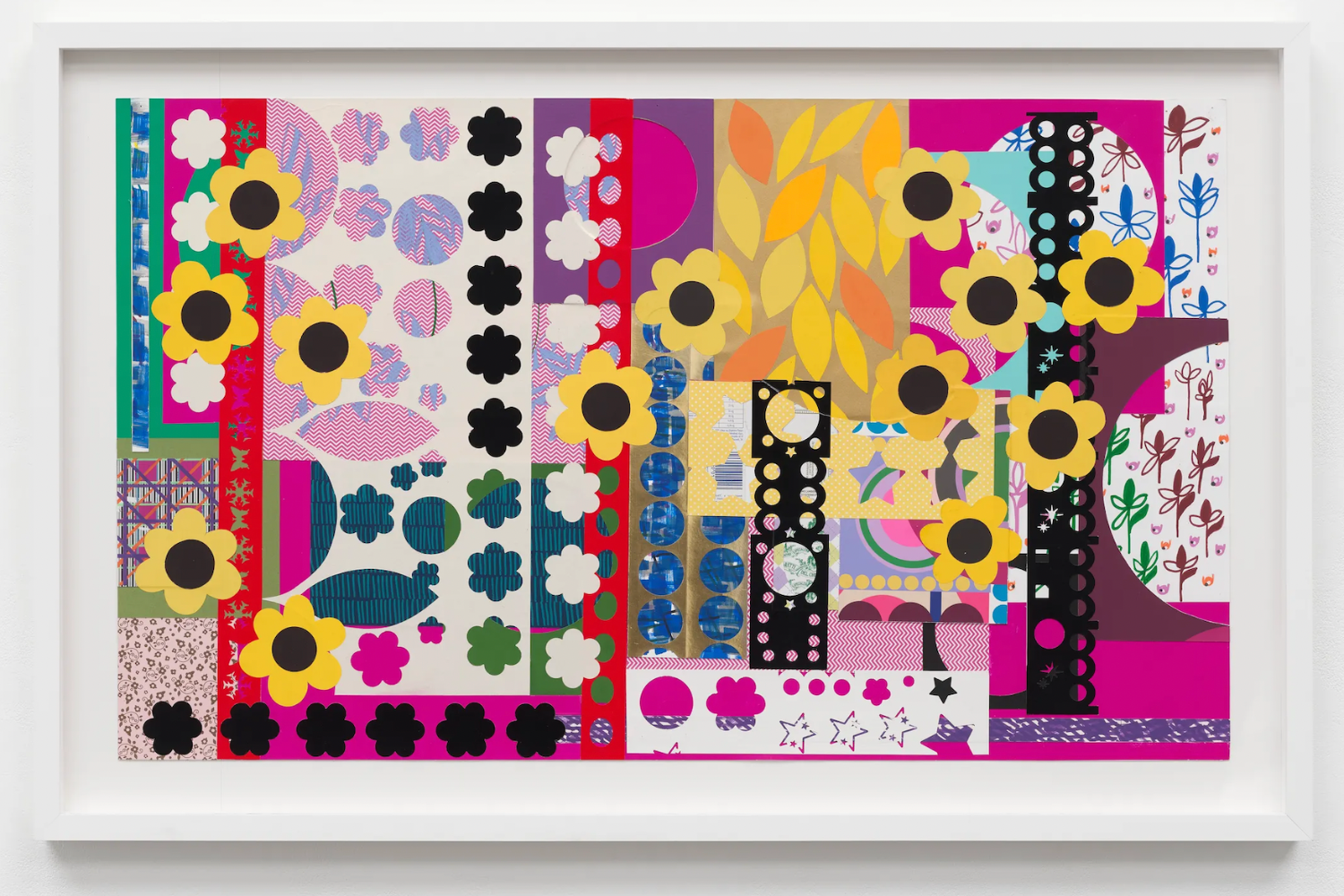
Next to the larger paintings, a series of small collages appear almost like miniature works. These incorporate materials such as cellophane, wrapping paper, and ribbons from luxury shops. The use of such materials highlights the everyday origins of Milhazes’s visual language and her interest in transformation through reuse and recycling. These collages could be read as preparatory studies, yet they also function as independent works. They may precede the larger canvases, or operate alongside them, continuing similar themes in a more modest, tactile, and intimate format.
Last year, Milhazes was profiled at Tate St Ives, in an exhibition that spanned four decades of her work, drawing British viewers’ attention to the multiple connections and exchanges between European and South American modernism. This exhibition at White Cube further develops this dialogue, showcasing Milhazes’s insistence of the possibilities inherent in the use of decoration within the abstract tradition. Pattern, repetition, and colour become a method for thinking about cultural hybridity, memory, and perception.
Ana Teles for London Art Walk
December 2025