
Brazil at the Venice Biennale: the plant that silences and the pavilion that speaks
Comigo-ninguém-pode is a toxic plant: if swallowed, it paralyses the vocal cords, silences. A common houseplant, found in Umbanda terreiros and backyard gardens, it carries a popular ambiguity: it poisons and protects. Curator Diane Lima, known among other works for her role in the 35th São Paulo Biennial, uses it as the title of the exhibition Brazil is bringing to the 2026 Venice Biennale, with the intention of laying bare the colonial wounds of a territory and its bodies. In “Fado Tropical”, a song critical of the Brazilian and Portuguese dictatorships, the chorus by Chico Buarque and Ruy Guerra adds a relational layer to the pavilion: “esta terra ainda vai tornar-se um imenso Portugal” – “this land will yet become an immense Portugal” (free translation). It is an irony written to speak of a country that dressed itself in the coloniser’s aesthetic over a body that never quite fit it. The Brazilian show is woven into this storyline, overflows, and lives up to the plant’s name, which signals that, in this space, it holds power, self-defence, and is untouchable.
The corridor leading into the recently renovated Brazilian pavilion at the Giardini della Biennale sets a pace of contemplation and, in some way, unease. The entrance immediately leads the visitor to look up at the ceiling, and the building’s architecture, an original 1964 design, leaves no other option but to follow the narrow corridor it defines. Adriana Varejão’s angels, printed on cracked tiles in shades of blue and red, watch without gestures of blessing or mercy. The promise of solidity that tiles carry, so familiar from domestic walls and colonial facades, goes unfulfilled. What should contain and hold steady instead lets things seep through, allowing the traumas of Brazilian history to run through the cracks. With no refuge or protection, the visitor is led by the failing tile work to the exhibition’s namesake piece, “Comigo-ninguém-pode”, by Rosana Paulino, a work in which the artist places the Black woman’s body at the centre of a web of threads and plants growing from her eyes, chest and fingertips, as a form of self-resistance, a way out of silence, and a means of survival against the unofficial history now spilling through every corner of the show.
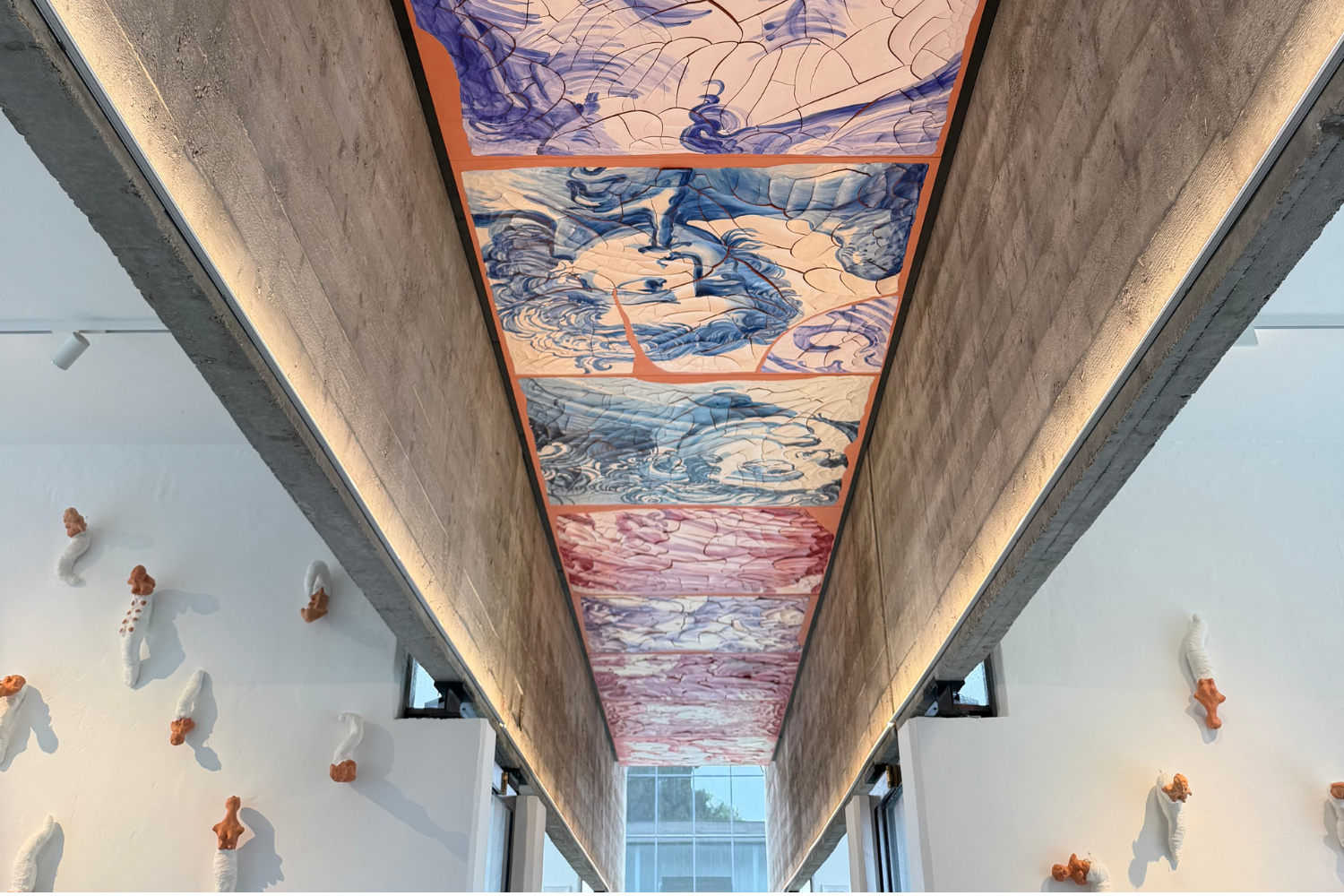
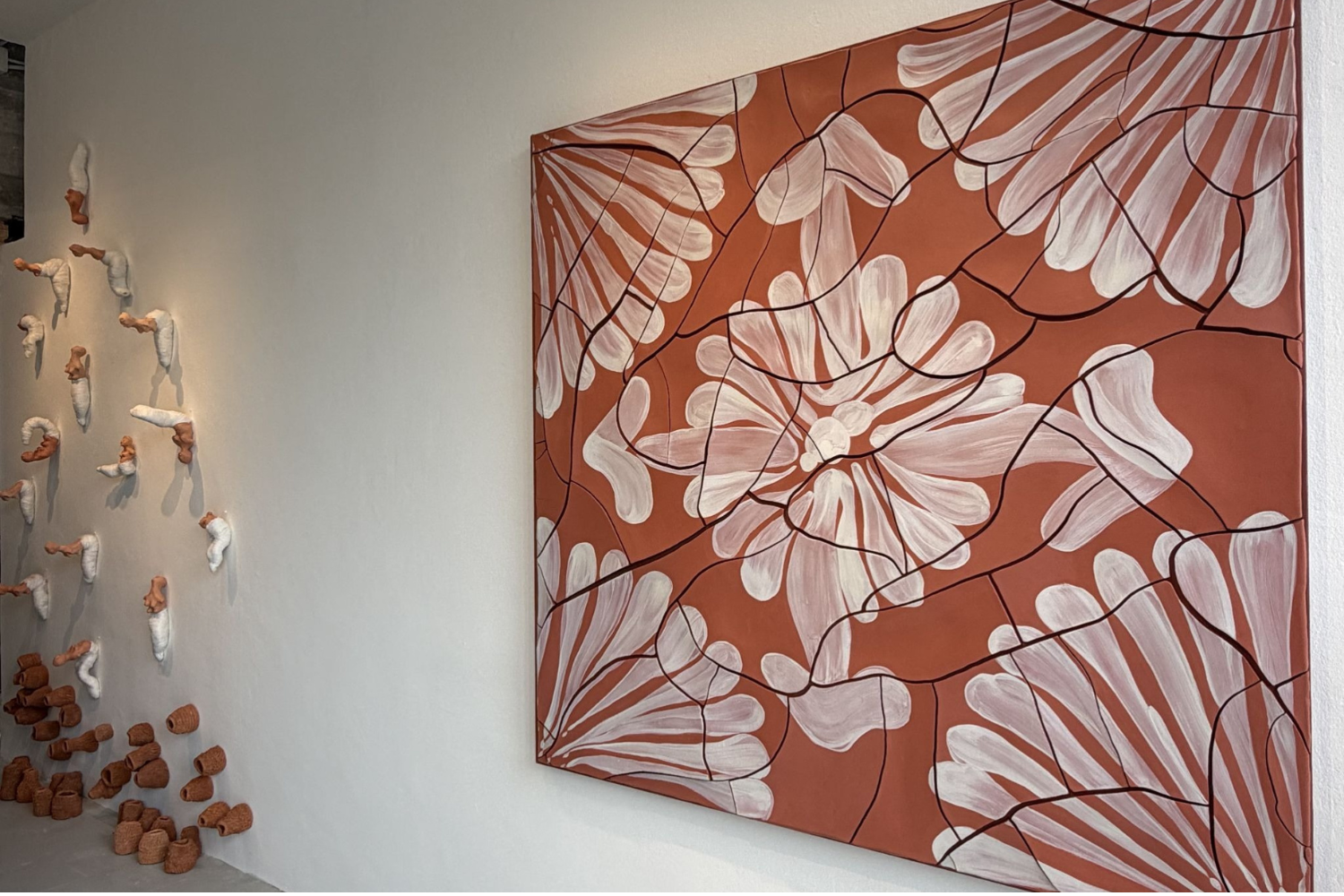
Just ahead, in Adriana Varejão’s canvas, colonial baroque tilework appears once again in a state of rupture: the fissures cutting through classical geometry reveal a pulsing, visceral surface, exposing how the order imposed by the coloniser was built on bodies and traumas that are now cracking open. In response to this torn condition, Rosana Paulino’s “Tecelãs”, occupying either side of the corridor, inhabit the space with a regenerative force. In these figures, the bodies of Black women merge with insects, becoming biological weavers who produce their own thread and encapsulate themselves. Where Varejão exposes the open wound of an “immense Portugal” splitting apart, Paulino’s women weave, over the rubble of that project, a web of protection and survival, turning silence into an architecture of ancestral resistance.
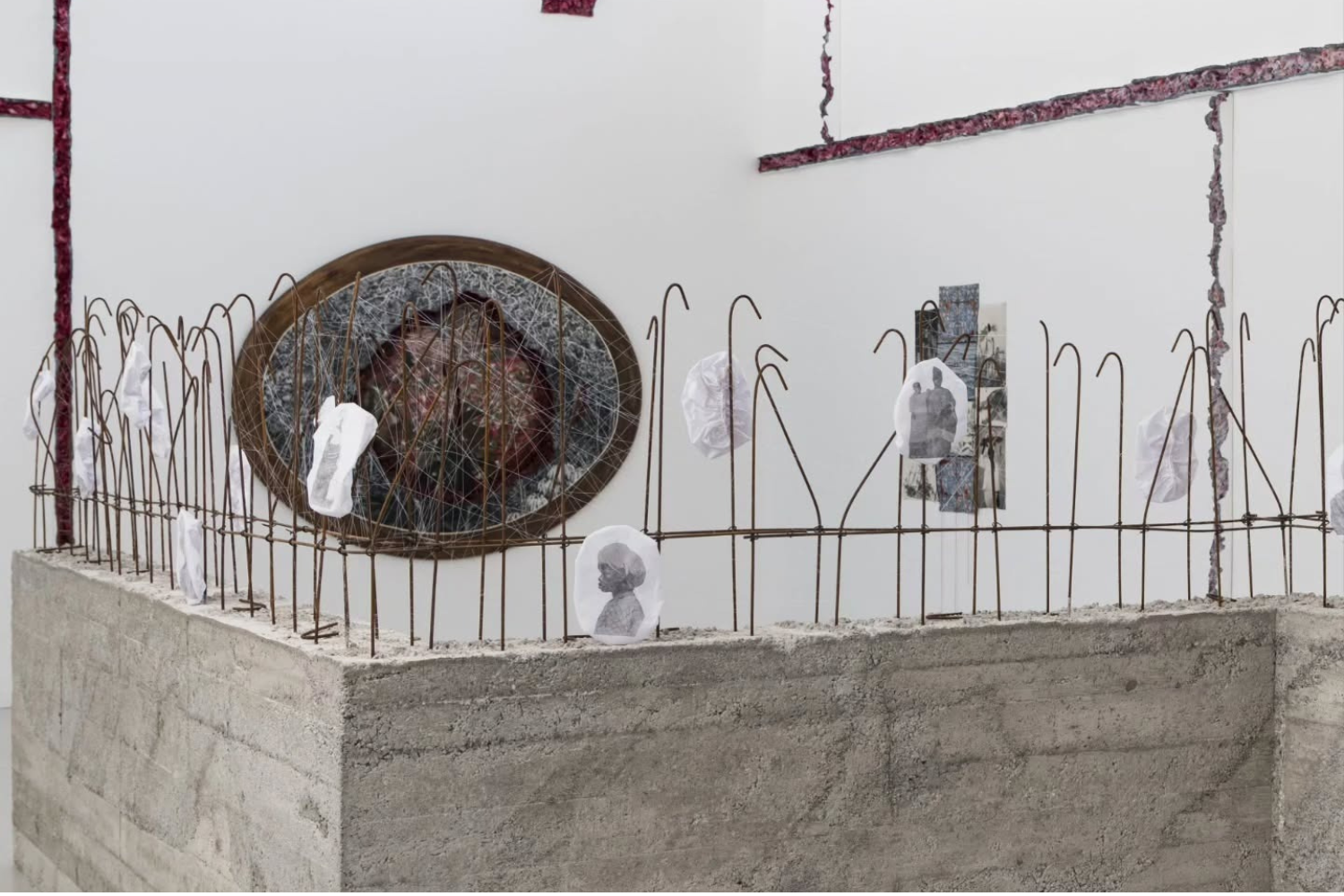
Further into the visit, the pavilion takes on an even more visceral charge in another standout room. The space is occupied by steel rods emerging from concrete, connected by networks of wire, a structure that at times concentrates, at others radiates outward, holding reproductions of historical images of enslaved women from Rosana Paulino’s archive. This web of iron and memory shares the space with Adriana Varejão’s fleshy fissures, whose cracks in the architecture extend the critique even to the white cube itself. The meeting between the coldness of concrete and the carnal quality of the surfaces once again demonstrates the complementarity of the two artists’ work in investigating colonial wounds. While Paulino’s installation evokes the strength of a collective body forced into extreme resistance, recalling her words that “Black Brazilian women had to identify with Iansã by force, because abolition came and they were left carrying the heaviest load”, Varejão’s work exposes the traumatic matter hidden beneath historical structures.
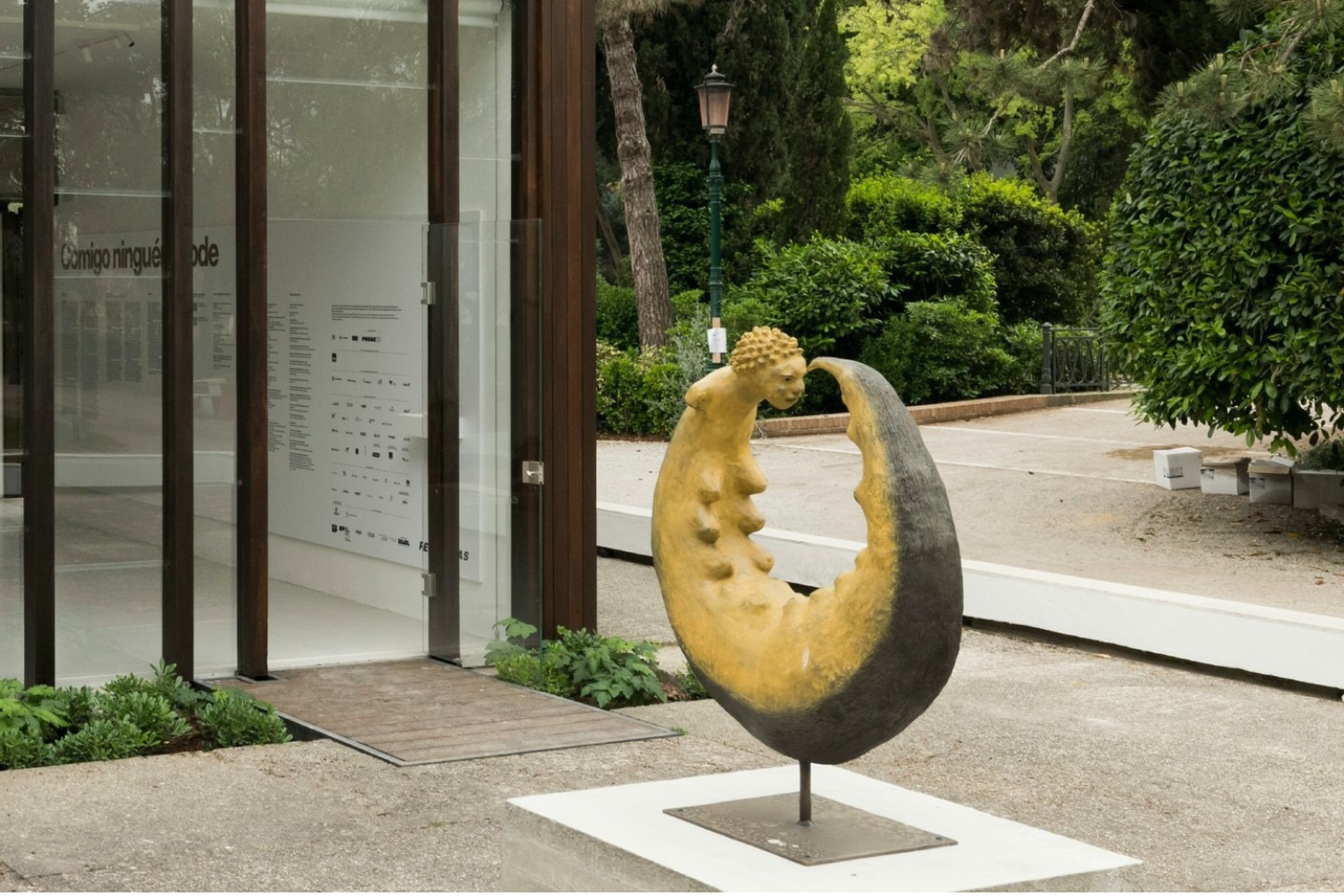
Outside the building, there are further works by both artists, but the standout is the new piece “Crisálida” by Rosana Paulino, a three-dimensional realisation of her 2005 work “Ninfa tecendo o casulo”. The bronze figure presents a woman producing, from her own body, the threads that form a cocoon around her. A chrysalis is the transformative stage of an insect’s life, the moment it closes in on itself before emerging as something new. In Paulino’s work, that withdrawal is not fragility: it is from within herself that the figure draws the material for change. Being in the space outside the pavilion perhaps means understanding this as an overflow of tensions that no longer fit inside, a pressure that must face the outside world, the public space. The work becomes a living presence, a sentinel watching over the present.
The Venice show gains historical depth through the work of both artists, bringing new pieces alongside others that are seminal to their trajectories. From Rosana Paulino, the Búfala series, in which the animal is linked to feminine force and the orixá Iansã, and the geopolitical weight of “Atlântico Vermelho” anchor the exhibition in the living memory of the diaspora. Adriana Varejão operates in the same field of destabilisation: in “Parede com incisões à la Fontana”, precise and violent cuts run across a white tiled surface. The reference is a direct one to Lucio Fontana, known for slashing his canvases to open up pictorial space. Varejão shifts that gesture to the tile, turning the cut into a symbolic fracture of Western visual tradition and its promises of order and stability.
The power of Diane Lima’s choice lies in the exhibition’s very name. In Brazil, Comigo-ninguém-pode is a plant of protection, used against the evil eye and bad energy. But in English it is known as Dumb Cane, where “dumb” carries the older sense of muteness, and the name is no coincidence: its sap irritates the vocal cords of anyone who ingests it, taking away their voice. The same plant that protects also silences, and it is precisely that tension that the exhibition feeds on. While the 2026 pavilion sets out to be a place of speech, of denouncement, of open wounds laid bare, it does so under the sign of a plant that has historically evoked muteness. Between the mystical protection of a people who resist by giving voice to their fractures and the biological silencing imposed by the poison, the Brazilian show in Venice places itself squarely in that fissure: a collective effort for the body that never fit the European aesthetic to turn its own “spilling over” into a cry of presence.
Marilia Lopes for London Art Walk
May 2026