
Comedian and Jerry Gogosian: The Art System as Performance
In recent weeks, two unrelated events in the art world have drawn attention to questions about the art market and the ways in which it operates. A banana stolen from Maurizio Cattelan’s ‘Comedian’ and the death of Jerry Gogosian, an Instagram persona who critiqued the contemporary art world, elucidate the processes through which value, legitimacy, and visibility are manufactured.
‘Comedian’
Since Maurizio Cattelan first made an appearance at Art Basel Miami Beach in 2019 with ‘Comedian’, a banana affixed to a gallery wall with a piece of duct tape, the work has become a repeated target for disruptive behaviour. Visitors ate the banana in 2023 and 2025, and in May 2026 the Centre Pompidou‑Metz announced that it had been stolen. (According to CNN, it was quickly replaced and the museum filed a complaint.)
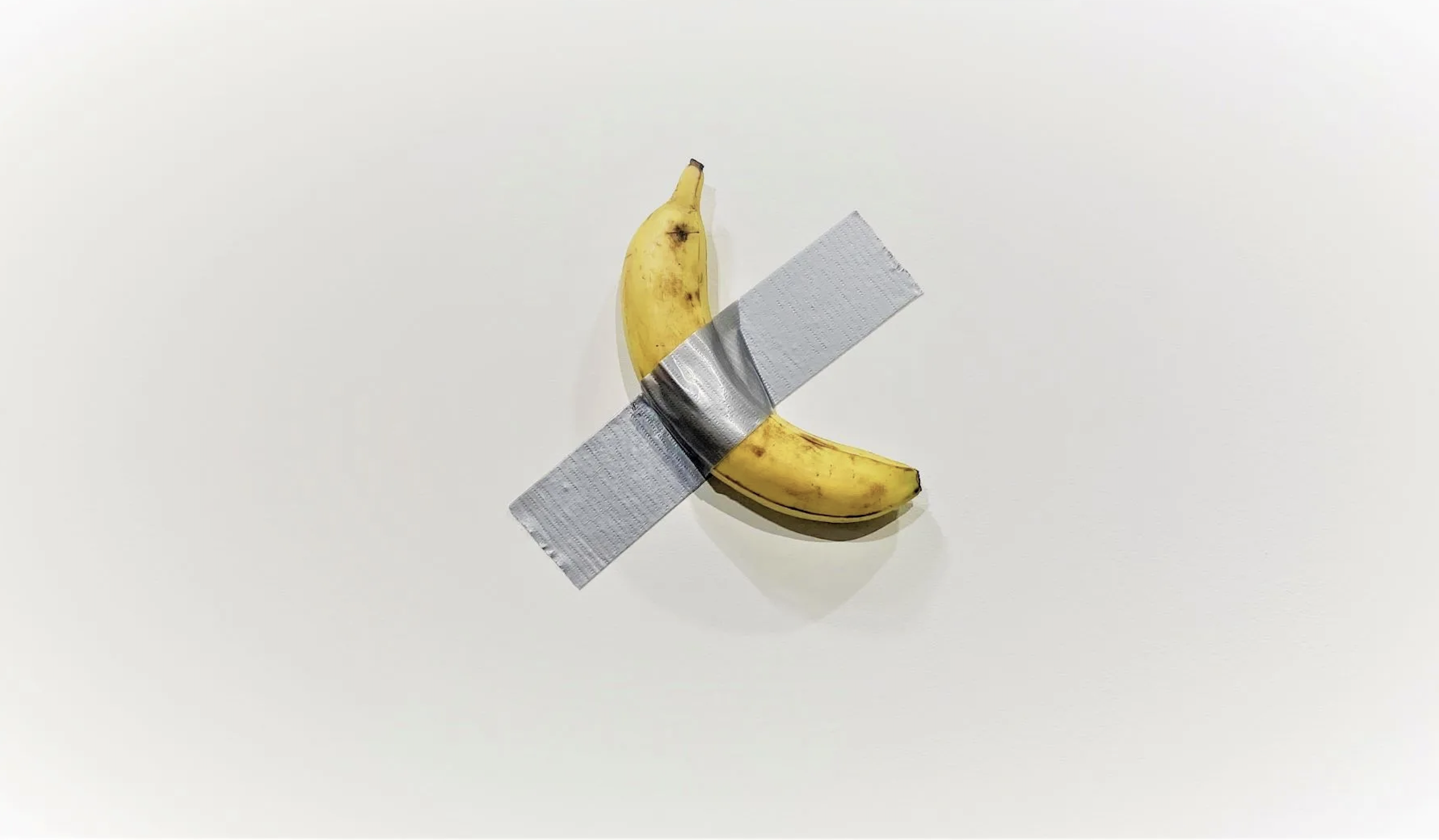
Conceptual works, like ‘Comedian’, are particularly vulnerable to attack by gallery visitors. When the point of artwork resides primarily in the idea rather than in the object, the status of the material component becomes extremely fragile. Anything done to the banana, to the strip of tape, or any other small gesture, can interrupt or expose the logic on which the work depends.
This all started with Marcel Duchamp’s Fountain (1917), in which a urinal, simply by the performative speech act of being declared an artwork, became one. This act of designation shifted the definition of art from craft to context and institutional authority. Decades later, Andy Warhol extended this logic in a different direction, moving the emphasis toward the cult of the artist, the signature, and the brand.
Cattelan’s work derives from this tradition of thought. He established the conditions under which an artwork can exist almost entirely through context, designation, and institutional agreement.
He described ‘Comedian’ as “a sincere commentary and a reflection on what we value,” offered for sale at an art fair. ‘Comedian’ is an institutional critique of the art market that is, ironically, part of the market itself.
Like many conceptual and rule‑based works, ‘Comedian’ exists through its protocol: museum staff replace the banana and tape every few days. This is standard practice. Richard Long’s floor pieces are assembled by technicians following his instructions; Sol LeWitt’s wall drawings are executed by others long after his death. The value of the artwork lives on in the agreement, not in any single physical instance.
What happens to the work when someone steals or eats Comedian’s banana? Very little. The value of ‘Comedian’ (which sold for $6.24 million in 2024) is secured by its certificate of authenticity and by “the protocol governing its presentation,” as the museum explained. The work persists through institutional validation and the social and legal frameworks that bring it into being.
When someone eats or removes the banana, they are not destroying the artwork, they are merely drawing attention to the systems that sustain it. And one of those systems is the art market itself, which ‘Comedian’ both critiques and embraces.
Jerry Gogosian
This brings us to the second event: the death of Hilde Lynn Helphenstein on the last day of May 2026. Known digitally as Jerry Gogosian, she emerged on Instagram in 2018 not as a producer of objects, but as a producer of institutional critique through the digital performance of her own persona. The name, a combination of Jerry Saltz and Larry Gagosian, synthesised two central figures in the field she was positioning herself against: criticism and the market. Through memes, ironic commentary, and observations about art fairs, galleries, and collectors, the account became an influential voice in digital critique, amassing 159,000 followers across 3,915 posts.
More than a meme account, Jerry Gogosian’s performance expanded into podcasts, newsletters, and public appearances that interrogated a tension inherent in the distance between art’s symbolic values, creativity and critical thought, and its growing entanglement with financial dynamics. Helphenstein stated that she was “obsessed with the performance of art in society and the unregulated market it masks” (Observer, 2021). Through this lens, the art world is a performative convention, and exposing that performance becomes an artistic act in itself. If the value of a work is dictated by a constellation of actors, gallerists, auctioneers, critics, then art is not an object but a violable social agreement.
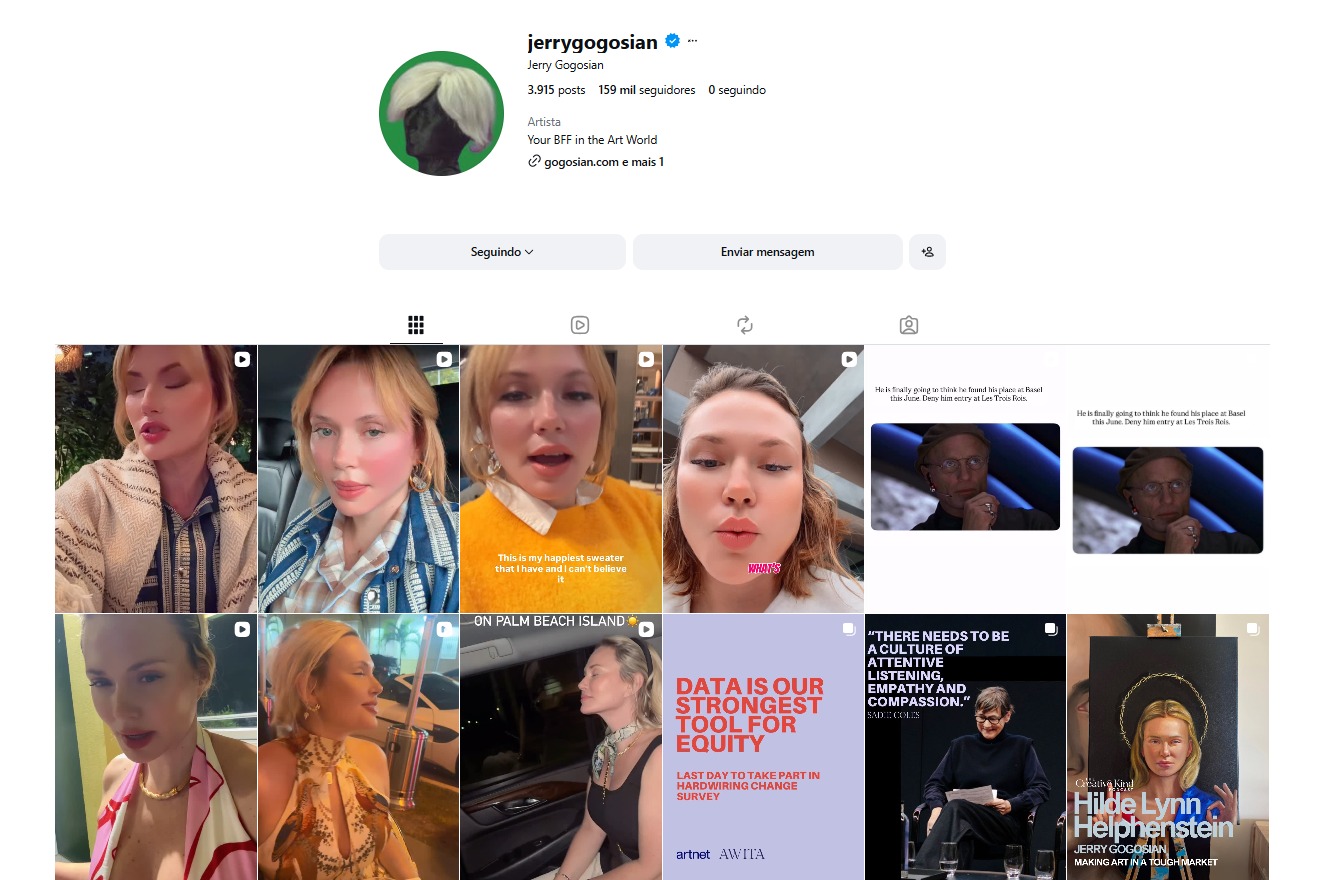
The practice of institutional critique, which emerged in the 1960s, identified that its target should not be the aesthetic object but the apparatus that decides what ‘counts’ as art: the museum, the gallery, the auction house. Helphenstein’s work belongs to this lineage, particularly through her digital performance. Whilst Hans Haacke, for instance, transformed the museum into a site of institutional autopsy through documentary findings, and Andrea Fraser, in ‘Museum Highlights’ (1989), deployed sarcasm to expose the elitism embedded in institutional language and protocol, Gogosian shifted the critique towards financialisation within the digital circuit. Using the caustic vernacular of social media, she laid bare the mechanisms operating in the private market, speculation, the artificial construction of reputations, and strategies of influence that determine an artist’s value long before any historical legitimation takes place.
The popularity of Gogosian’s work helped pave the way for moments of public reckoning, such as the dismissal of a director at Gagosian Gallery in 2020 (Art Forum, 2020), exposing the capacity of her digital practice to strain and destabilise the art system’s power dynamics. There is, however, a paradoxical dimension to all this: that very efficacy was swiftly absorbed by the market. Projects such as “Suggested Followers”, in partnership with Sotheby’s, and her representation by United Talent Agency (UTA) illustrate the phenomenon of co-optation, whereby the system neutralises dissent by absorbing critique and converting it into a mechanism of valorisation and distinction within the art world itself. By signing with a Hollywood powerhouse, the Gogosian persona revealed that, today, the market does not merely tolerate critique but industrialises it as a hallmark of sophistication, confirming that rebelliousness, when well performed, has become one of the most valuable commodities in the global art circuit.
When we place ‘Comedian’ and Gogosian side by side, the contemporary art system reveals itself as a game of conventions. In both cases, the work, whether a piece of fruit taped to a wall or a collection of memes posted on Instagram, functions as a trigger for an institutional performance. Cattelan’s banana, reinforced by the subsequent disruptions to the work, forces us to confront the absurdity of a protocol that confers value upon a perishable object through a contract; Gogosian’s persona compels us to confront the absurdity of a market that sustains itself through the management of influence. Yet what both lay bare is the more unsettling note: the market’s capacity not only to absorb critique, but to monetise it. When the art system absorbs institutional critique, folding it into the exhibition circuit and the market, it is not being challenged. It is consolidating itself.
Ultimately, both the conceptual object and the digital persona expose the same truth: in a largely unregulated ecosystem, dissent is a valuable product. The market does not fear critique; it performs it. And in doing so, it ensures that the question ‘what is art?’ remains, above all else, a question about the price of our consent.
Marilia Lopes & Ana Teles for London Art Walk
June 2026