
Anish Kapoor at the Hayward Gallery
Anish Kapoor’s aesthetic exploration of how objects inhabit, distort, and negate space is on full show at his Hayward Gallery exhibition, inviting visitors to immerse themselves in the ideas that have pre-occupied him for the past four decades.
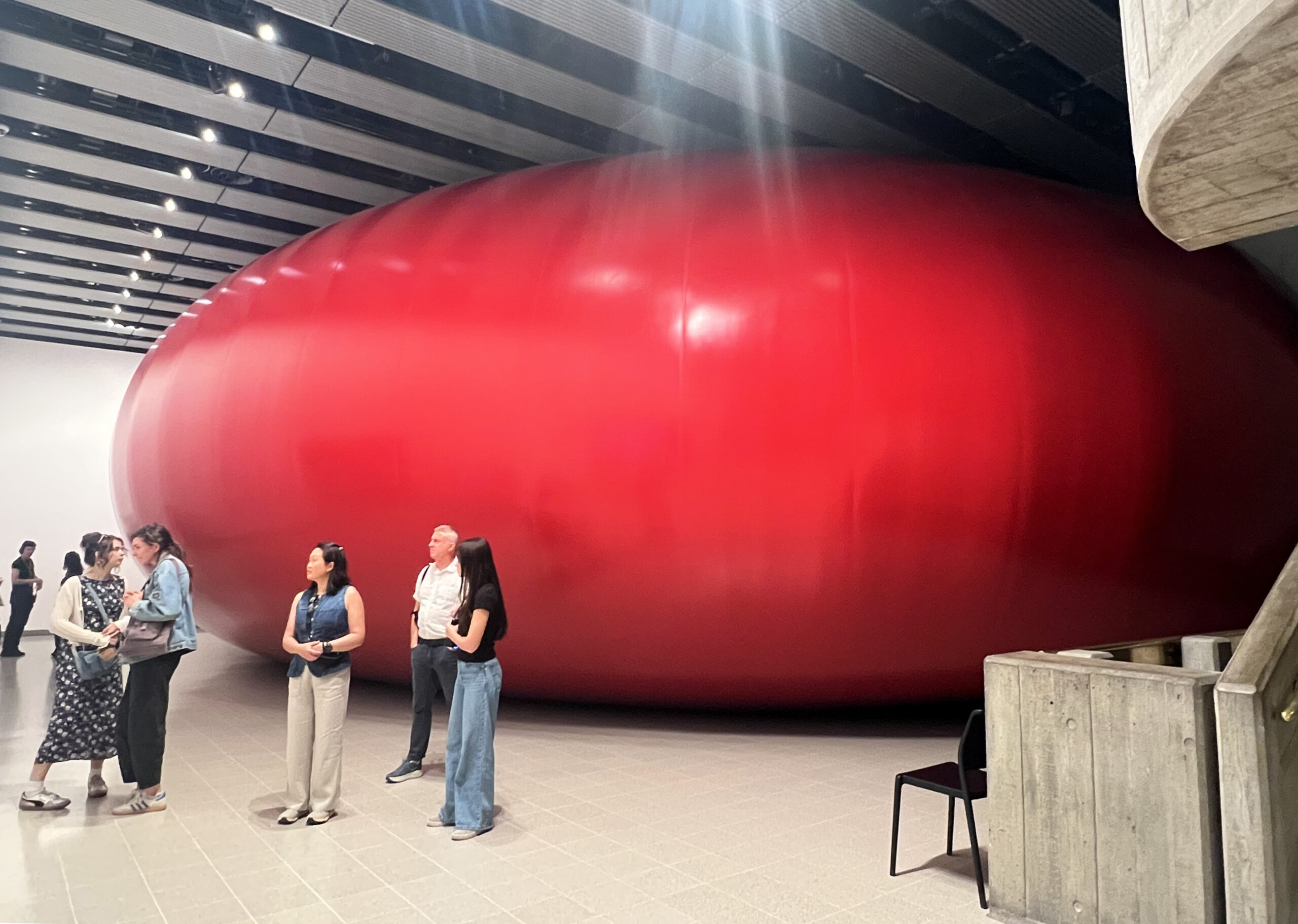
Those who are familiar with the Hayward’s gallery spaces will find themselves somewhat disoriented as they arrive in the large first room and find themselves confronted by an enormous, red, air-filled doughnut, which stretches from wall to wall, occupying the entire space where paintings would normally hang. This giant, anonymous, alien object feels foreign and intrusive, pressurising visitors to reroute themselves into an adjoining room. Kapoor is interested in how monumental forms intrude upon human movement, and here, at the very start of the exhibition, he insists that the viewers must immediately enter into negotiation with the object’s mute presence.
In the second room, viewers gather around a series of wall-based works, peering, puzzling, and second‑guessing their initial perceptions. The surfaces appear to be concave or convex, or to be flat or perforated. Kapoor has long exploited these perceptual dualities, provoking visitors to engage in a choreography of doubt, as they attempt to decode whether what they think they see corresponds to what is actually physically present.
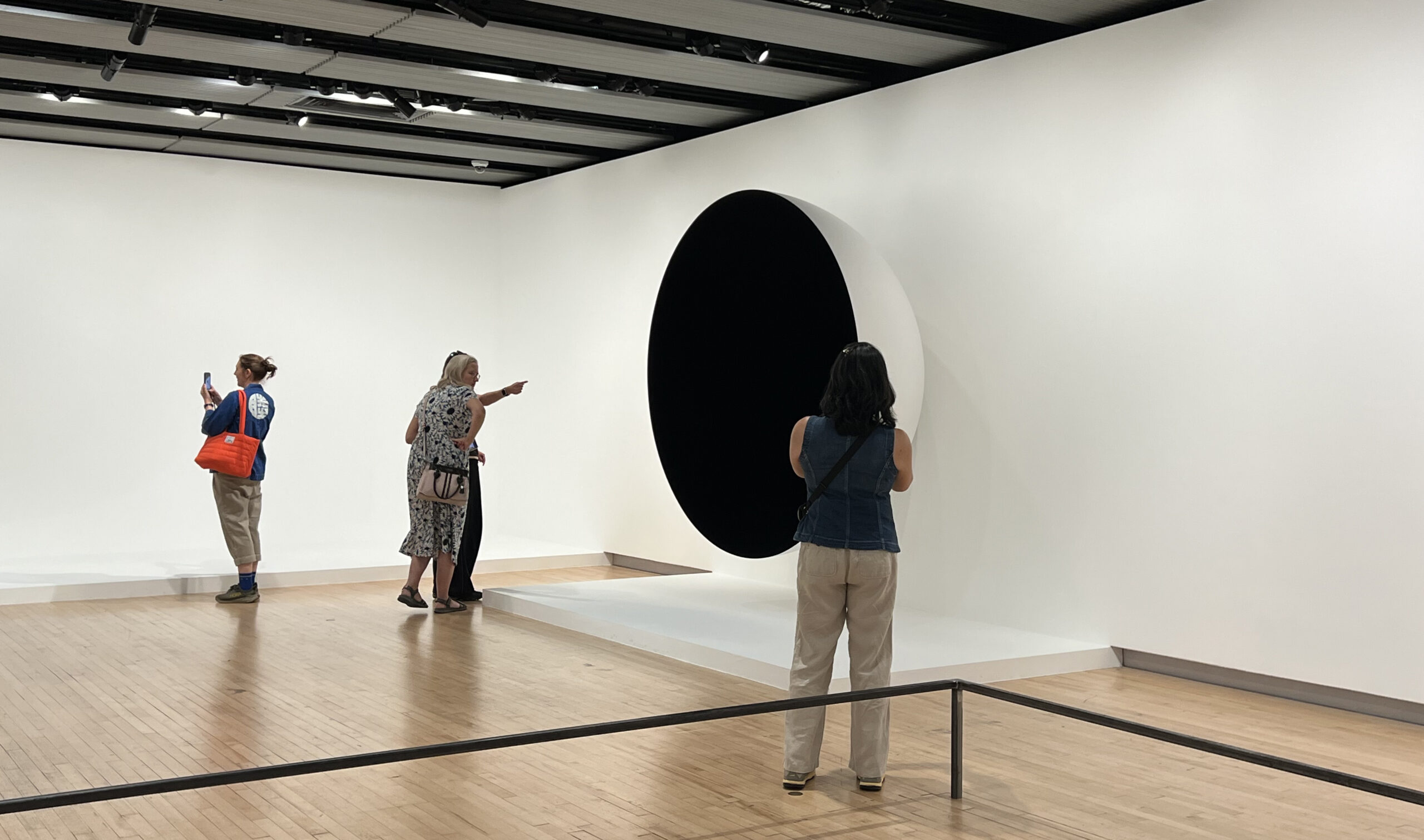
Kapoor’s use of ultra‑black pigment accentuates this mood of uncertainty. Following the lineage of Yves Klein, who famously trademarked his own shade of blue, Kapoor has secured exclusive rights to a proprietary black pigment known for its extreme light absorption. This material consumes up to 99% of visible light. In practical terms, this means that any surface coated with it loses its readable curvature, shadow, and depth. The effect is akin to the fashion-world logic of the colour black as slimming, where black conceals the contour of the body. In Kapoor’s work this makes a protrusion indistinguishable from a recess, and a cavity is read as a flat plane. The viewer’s visual system is contradicted by their spatial intuition.
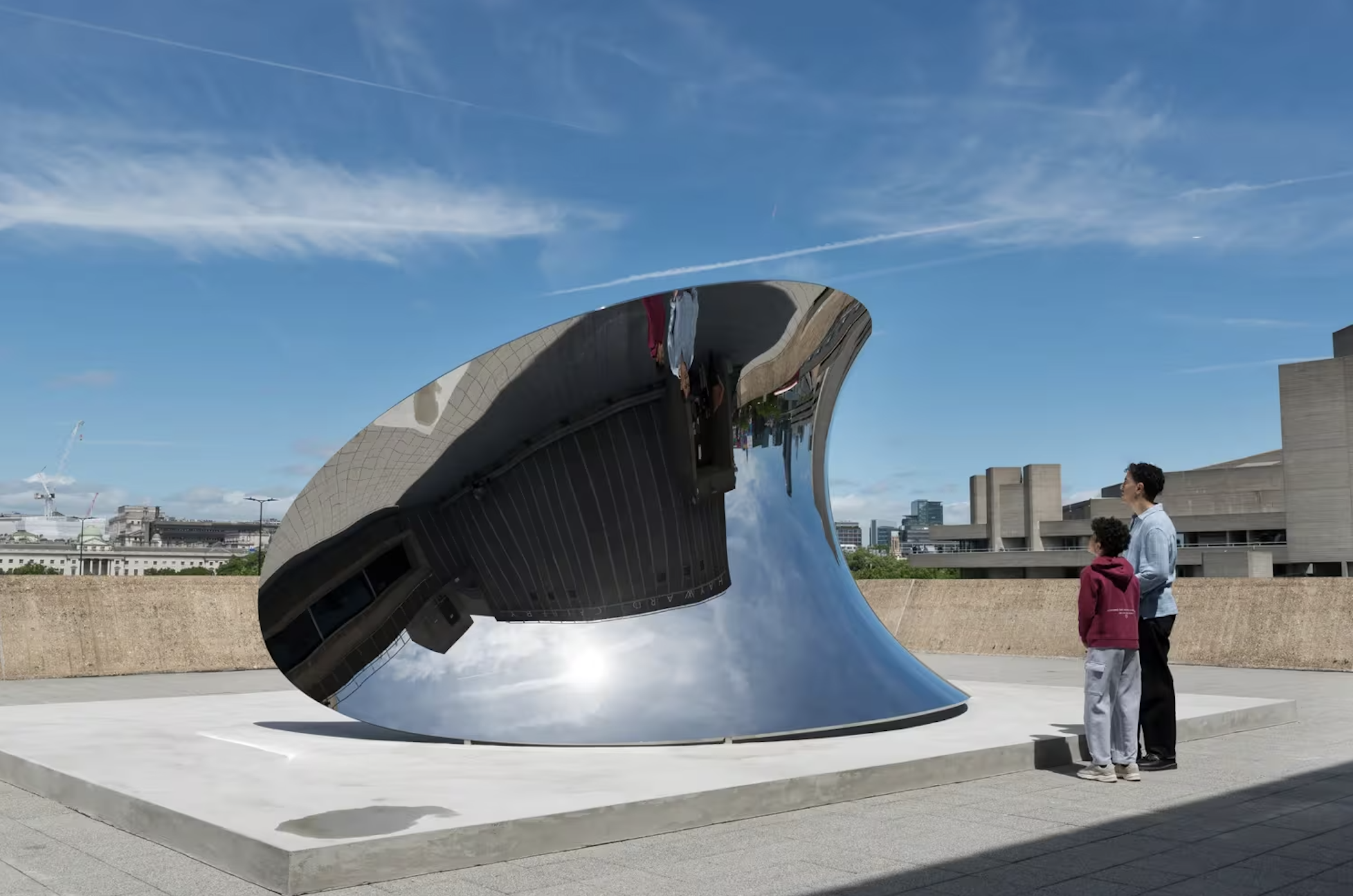
This room also contains some of Kapoor’s mirrored pieces that, in opposition to the black that absorbs light, expand the viewer’s sense of space. The mirrored sculptures reflect the gallery environment back to the viewer, but it appears upside down or shifted laterally, as if the world has slipped from its axis. Upstairs, two balcony installations of bright, curved, polished metal generate similar effects in the bright London sunlight.
The final rooms shift in theme from optical disorientation to visceral disgust. A towering mass of material descends from the ceiling, resembling a coagulated mountain of bodily matter. This feels like wandering the set of Stranger Things’ “Upside Down”, a world made of pulsing vines, organ-like growths, and fungal moulds, that recall living organisms or those about to be born. Nearby, brightly painted organic forms, wrapped in translucent membranes, evoke suspended bodies or specimens awaiting forensic examination.
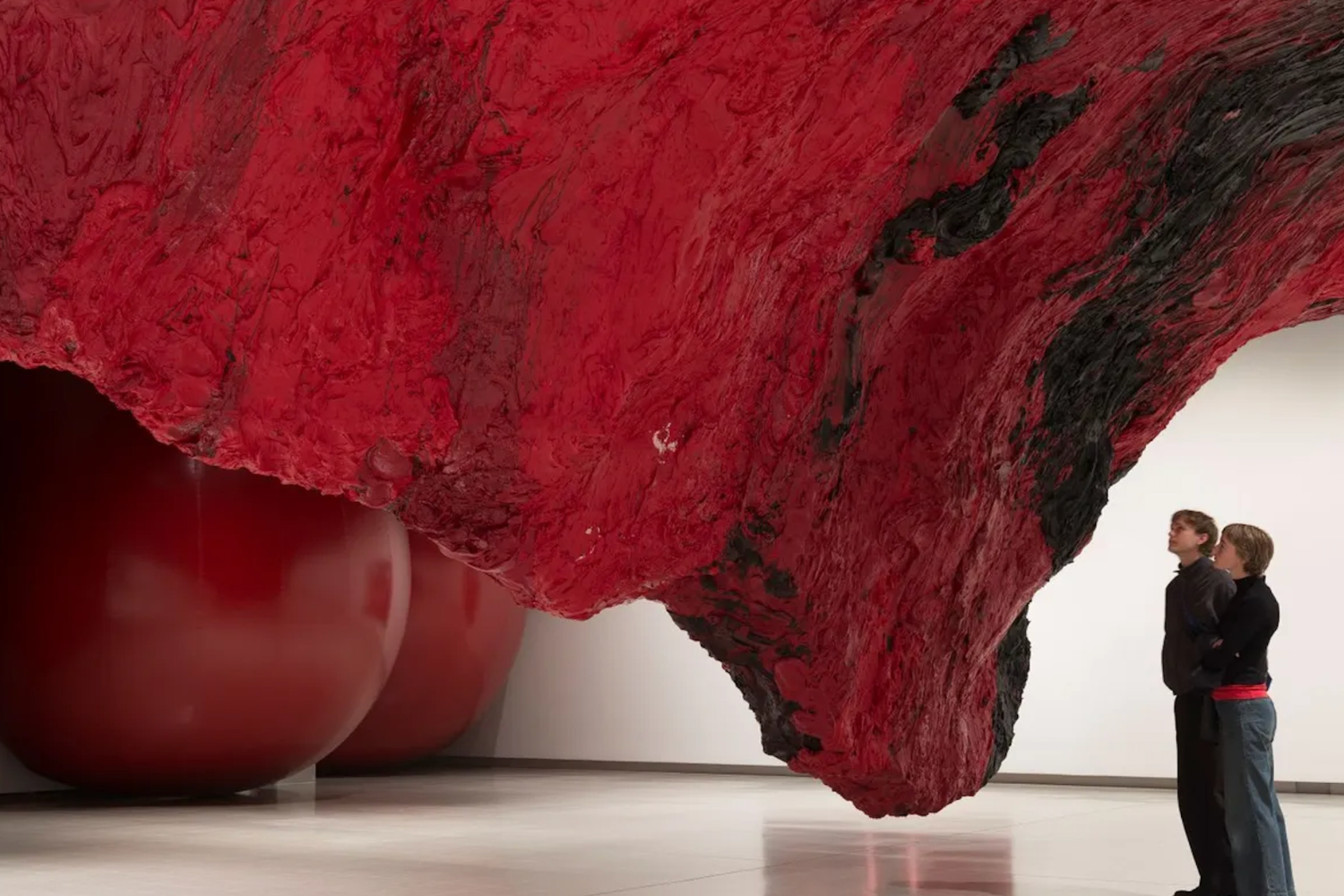
These works remind us of Kapoor’s ongoing engagement with the abject, the carnal, and the vulnerable border between inside and outside. Their materiality is a metaphor for rupture, violence, and the porousness of the human body.
Kapoor is interested in how objects behave in space, and how space behaves around objects. His preferred materials – reflective steel, ultra‑black pigment, pressurised PVC, and resin – are chosen for their capacity to manipulate our perceptions, and leave us in doubt.
Ana Teles for London Art Walk
July 2026