
Market transformations and collector behaviour: insights from Frieze, Art Basel and the Survey of Global Collecting 2026
What factors determine the value of a work of art, and how do buyers navigate the uncertainties inherent in this market? According to sociologist Raymonde Moulin, in the market for older art, aesthetic values are consolidated over time and through history. In the contemporary art market, however, supply is potentially unlimited and, in her words, “l’estimation de la valeur artistique est dominée par l’incertitude”, the assessment of artistic value is dominated by uncertainty. Against this backdrop, the Art Basel and UBS Survey of Global Collecting 2026, compiled by Arts Economics, offers an insight into how collectors are responding to these uncertainties.
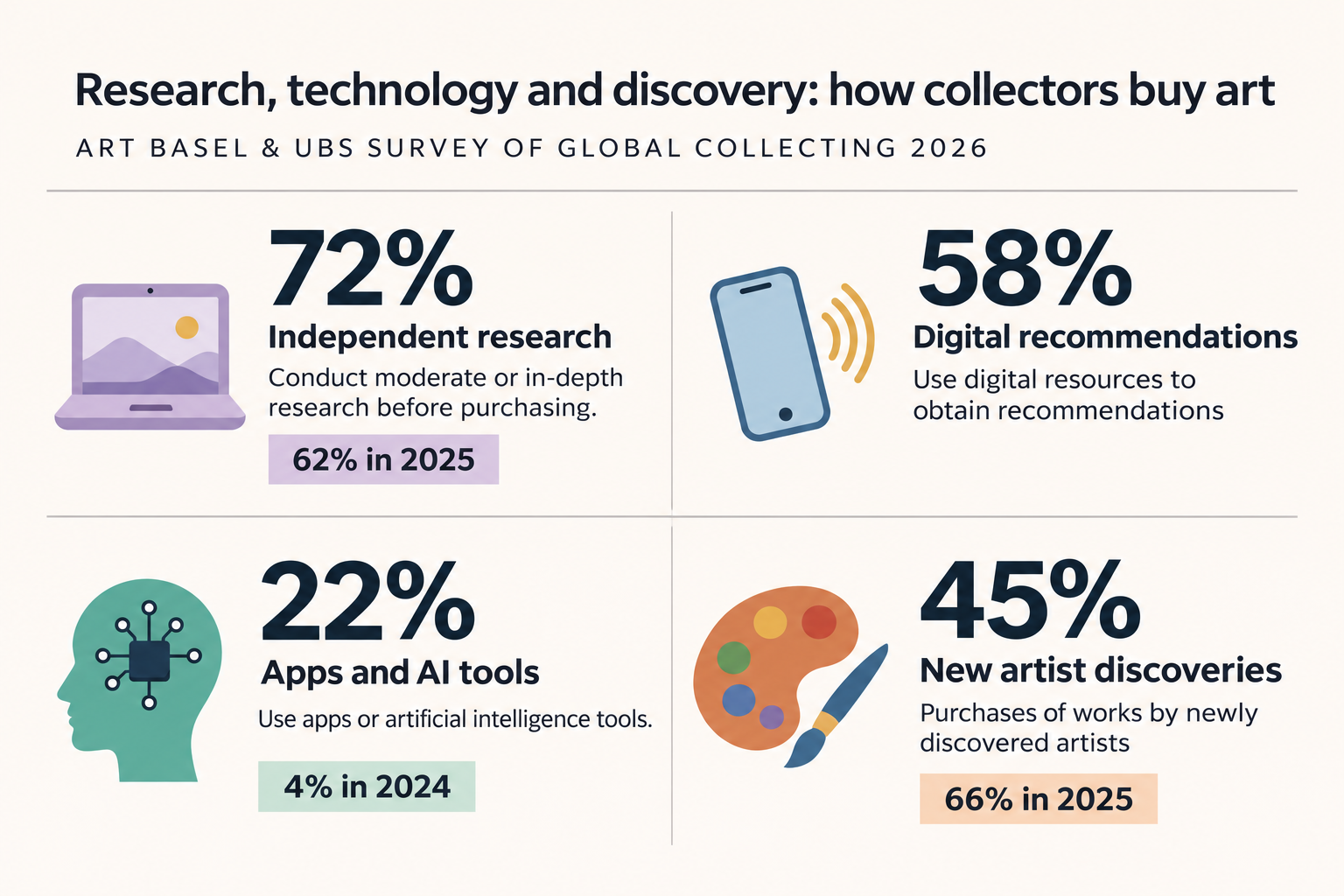
Based on responses from 3.100 high-net-worth collectors across 10 markets, the survey points not only to an increase in pre-purchase research, but also to collectors’ growing reliance on different tools to guide their decisions. The growing use of apps and AI tools is introducing new ways of researching and evaluating works of art. Yet an important question remains: do these technologies help collectors make more informed decisions, or do they simply add another layer to the mechanisms through which artistic value is assessed?
The survey also highlights changes in the profile of art buyers. Gen Z recorded the highest average spending of all generations surveyed, at more than twice the level of any other age group. At the same time, uniqueness and rarity emerged as important attributes for collectors: 43% of respondents identified these qualities as the most important aspects of owning a work of art, rising to 48% among Gen Z collectors. By contrast, the proportion of respondents who purchased works by artists they had only recently discovered fell from 66% in 2025 to 45% in 2026. This suggests a more cautious approach to unfamiliar names, although Gen Z collectors remain more open to discovering new artists than their older counterparts.
Another aspect highlighted by the survey is the relationship between public exposure and privacy. Among Gen Z collectors, 36% said they kept online content about their collections within private circles, while 42% reported using closed groups or invitation-only spaces. These figures point to a generation that combines intensive use of digital tools with more selective forms of sharing and engagement. As Noah Horowitz, Chief Executive Officer of Art Basel, has observed, engaging these new collectors involves multiple touchpoints, including trusted relationships, personalised experiences, and both in-person and digital encounters. The presence of digital platforms, therefore, does not diminish the importance of direct contact; rather, it broadens the ways in which these relationships are established.
This dynamic can be considered in light of sociologist Lucien Karpik’s concept of “judgment devices”. In markets where the quality of goods cannot easily be established through objective criteria, these devices help buyers make informed choices and navigate uncertainty. Galleries, specialists, critics and institutions all contribute to this process by conferring recognition and legitimacy on artists and their works. Digital platforms and artificial intelligence tools are now broadening the range of information available to collectors, but they do not necessarily replace these established sources of reference. The tools may change, but the need for points of reference when assessing and assigning value remains.
It is against this backdrop that the latest editions of Frieze London and Art Basel Paris become particularly interesting. Beyond serving as marketplaces, art fairs operate as spaces for mediation, recognition and interaction between different market players. Both fairs took place last month, albeit under very different circumstances. In London, galleries faced mounting pressure from rising operating costs, commercial property taxes (business rates) and transport expenses, compounded by the bureaucratic and logistical requirements resulting from Brexit,challenges that had already been highlighted in previous editions. In Paris, meanwhile, demonstrations and incidents of violence over the weekend before the fair opened raised security concerns and affected its programme.
Despite these contrasting circumstances, both fairs attracted international buyers and presented distinct commercial approaches.In London, the combination of established artists and emerging names created opportunities for new discoveries, while smaller galleries found receptive audiences for more experimental works at more accessible price points. In a report published by The Art Newspaper, some gallerists said that buyers were taking longer to make decisions, while others remained willing to invest in established artists. The picture suggests a more cautious market, but one that still offers room for experimental proposals and different commercial strategies.
At Art Basel Paris, meanwhile, there was a strong presence of modern, post-war and established contemporary artists, although the fair also featured less established galleries and artists. One of the most notable sales was Gerhard Richter’s “Rokokotisch (Rococo Table)”, sold by Hauser & Wirth for approximately US$10.5 million during the VIP preview. According to Art Basel figures reported by Artnet News, more than 300 works were sold, generating approximately US$147 million in sales over the first two preview days. The programme also included Avant Première, aimed at galleries’ top clients, alongside private presentations, institutional exhibitions and at least 12 satellite fairs across the city.
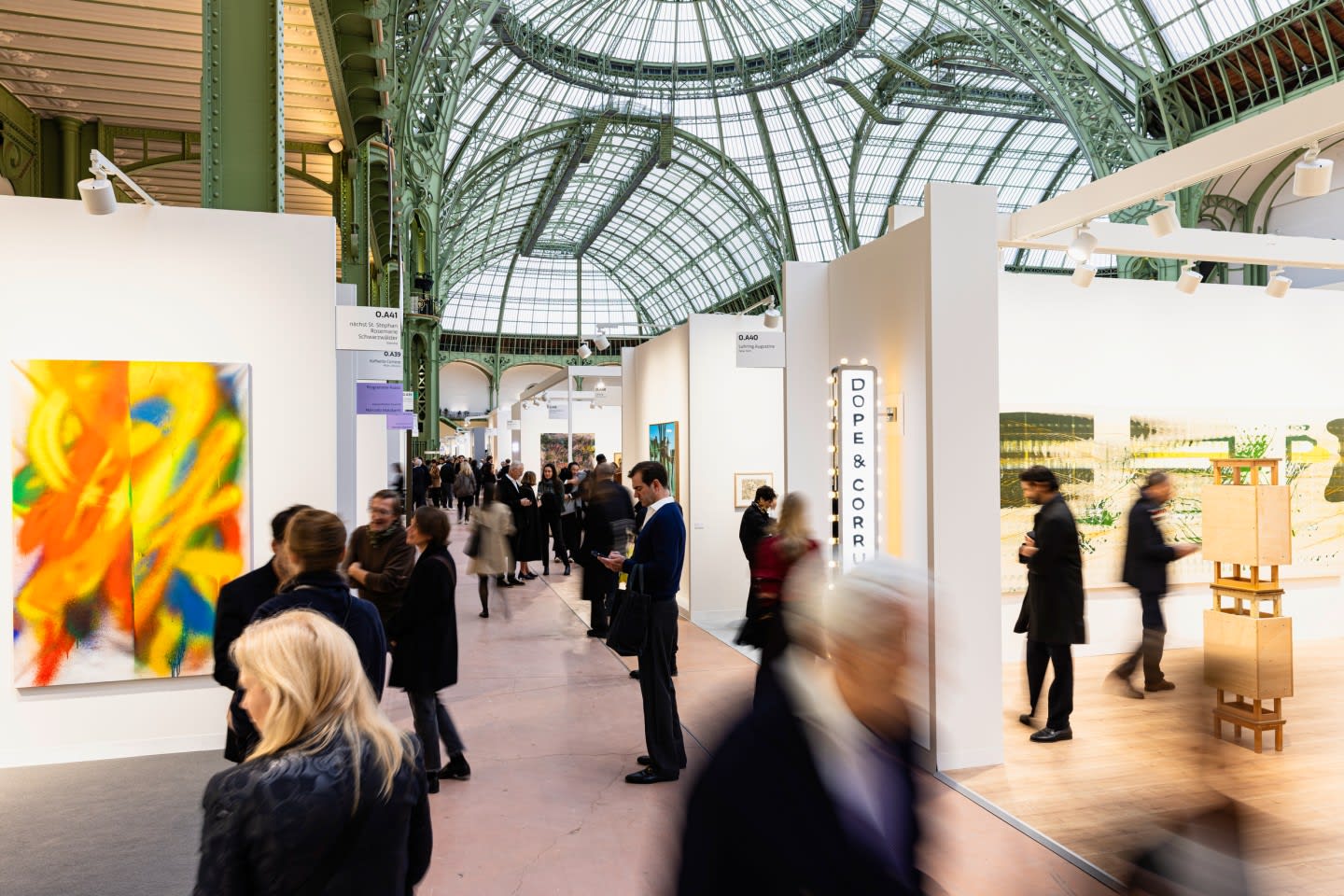
The demonstrations in Paris, however, had consequences for the event itself. In response to forecasts of further protests on Saturday, 24 October, the organisers announced that the fair would close two days earlier than scheduled. A 20% reduction in the basic booth fee was subsequently offered to all 211 exhibiting galleries, following the disruption.
The differences between London and Paris should not be understood as a rigid opposition between discovery and established recognition. Both fairs brought together artists from different generations and price brackets, while highlighting distinct commercial priorities and presentation strategies. As María Sancho-Arroyo notes in an analysis published by Arte al Día, art fairs reflect their own identities, audiences and dynamics, which do not necessarily place them in direct competition.
When considered alongside the findings of the Survey of Global Collecting 2026, these differences reveal how art fairs are adapting to changing patterns of collecting. In a market where collectors are conducting more research, using new digital tools and becoming increasingly selective about their acquisitions, art fairs need to offer more than purchasing opportunities: they must provide experiences of discovery, access and engagement. New tools are broadening access to information and transforming the ways in which buyers substantiate their decisions, but they do not eliminate the uncertainty that, as Raymonde Moulin observed, characterises the contemporary art market. Rather, they are changing the tools, relationships and sources of information through which market participants seek to navigate it.
References
ART BASEL. Gen Z has a surprising preference for bricks-and-mortar galleries. 17 February 2025. Available at: https://www.artbasel.com/stories/gen-z-art-collectors-galleries-wechat-instagram.
ART BASEL; UBS. The Art Basel and UBS Survey of Global Collecting 2026. 2026. Available at: https://www.artbasel.com/stories/the-art-basel-and-ubs-survey-of-global-collecting-2026.
ARTNET NEWS. Art Basel offers discounts to Paris exhibitors after early shutdown. 2026. Available at: https://news.artnet.com/market/art-basel-paris-2026-compensation-2834991.
ARTNET NEWS. Sales were brisk inside Art Basel Paris’s ‘Big Glass Bubble.’ Then the shutdown came. 2026. Available at: https://news.artnet.com/market/art-basel-paris-2026-sales-protests-early-closure-2823843.
HARRIS, Gareth. Art Basel Paris to close early due to protests. The Art Newspaper, 22 October 2026. Available at: https://www.theartnewspaper.com/2026/10/22/art-basel-paris-closes-early-due-to-protests.
JHALA, Kabir; GRONLUND, Melissa. At Frieze London, some buyers are taking risks—others are taking their time. The Art Newspaper, 15 October 2026. Available at: https://www.theartnewspaper.com/2026/10/15/frieze-london-buyers-taking-risks-others-are-taking-their-time.
KARPIK, Lucien. Valuing the Unique: The Economics of Singularities. Translated by Nora Scott. Princeton: Princeton University Press, 2010.
MOULIN, Raymonde. La construction des valeurs artistiques contemporaines. Cahiers de recherche sociologique, n. 16, p. 17–22, printemps 1991. Available at: https://doi.org/10.7202/1002125ar.
SANCHO-ARROYO, María. London and Paris: Two Weeks Taking the Pulse of the Art Market. Arte al Día, 29 October 2026. Available at: https://www.artealdia.com/MARKET/LONDON-AND-PARIS-TWO-WEEKS-TAKING-THE-PULSE-OF-THE-ART-MARKET.
Marília Lopes for London Art Walk
November 2026