
Between Forms, Signs and Constellations: Miró Comes to São Paulo
Lines that become signs, essential forms and colours of great intensity: Miró built a visual language as singular as it is immediately familiar. That apparent simplicity is the result of a long process of refinement, through which the artist progressively reduced his figures without losing their expressive force. Miró explained this himself in a conversation with Yvon Taillandier in 1959: “My figures underwent the same simplification as my colours. Simplified in this way, they are more human and more alive than they would be if represented in every detail. Represented in detail, they would lose their imaginary quality, which enhances everything.” By stripping away detail, he does not make his figures less expressive. Quite the opposite: a line, a form or a colour ends up suggesting more than it represents.
It is this language that lies at the heart of Miró: Mestre das Formas, which brings together more than 100 works by the Catalan artist at MAB FAAP in São Paulo. Drawn from institutions including the Fundació Joan Miró in Barcelona, the Fundació Pilar i Joan Miró in Mallorca, the Es Baluard Museu d’Art Contemporani and private collections, the works span more than seven decades and cover different moments of his career. Paintings, prints, lithographs, sculptures and tapestries show how Miró’s investigation into form, colour and sign shifts depending on the material, the scale and the process. Photographs and documentary material, meanwhile, offer a closer look at the artist, his working environment and the contexts in which this language developed. Some of these works have never been shown in Brazil before; others had never left Spain.
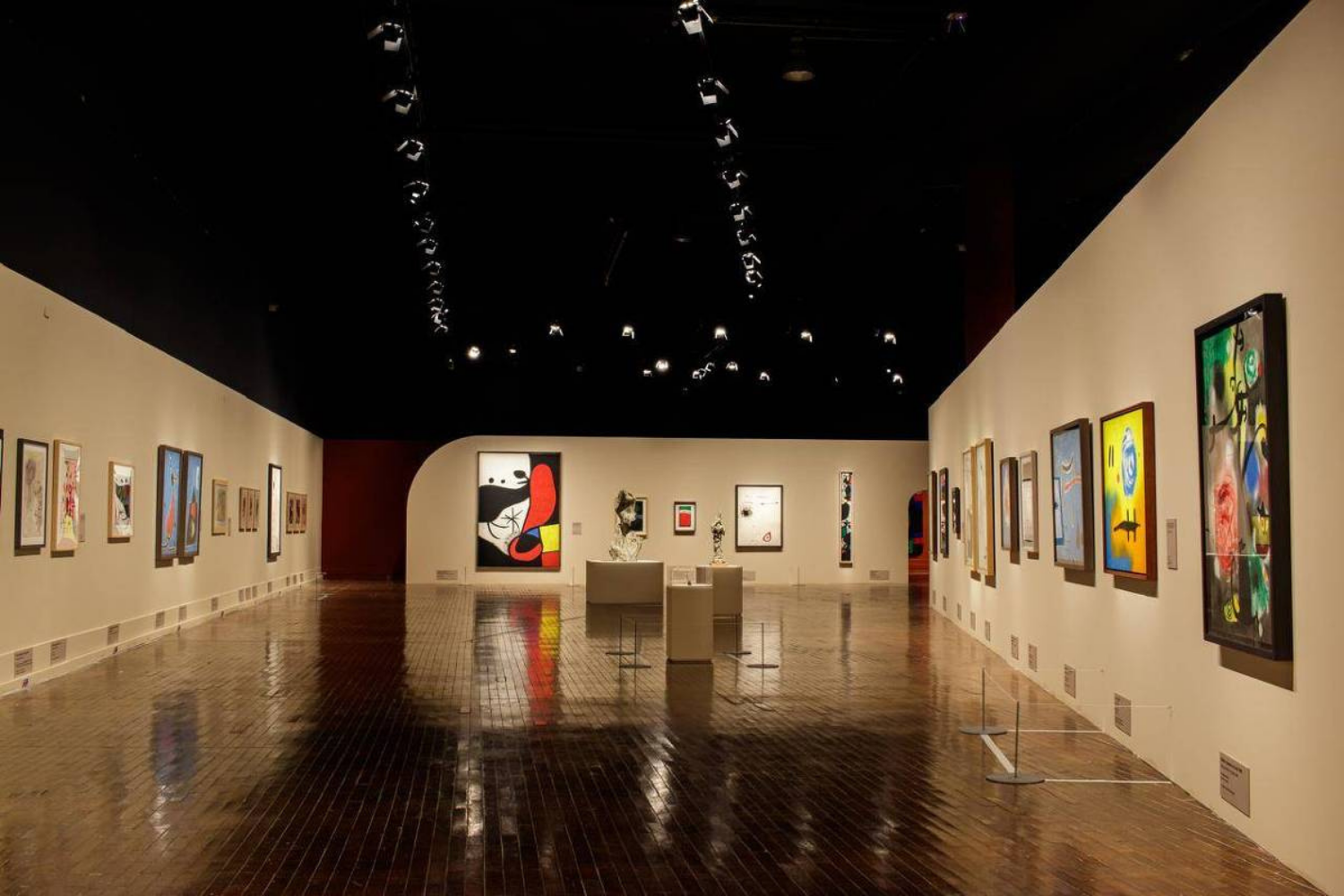
The exhibition is organised around six thematic sections: A Vocabulary of Signs, The Sign in Freedom, The Object, Black Figures, Women, Dogs and Insects, and Great Syntheses. Rather than following a chronological narrative, the selection traces the development of a language. Instead of simply moving from one period to the next, the visitor keeps encountering the same elements, women, animals, stars, eyes, lines and marks, returning in transformed versions across time. The sections reveal how Miró continuously returned to a relatively contained repertoire to explore new possibilities of form, colour and matter.
Joan Miró was born in Barcelona in 1893 and died in Mallorca on Christmas Day 1983. Across more than seven decades of work, he built a practice in dialogue with different movements, Surrealism, Fauvism and Cubism, without being entirely defined by any of them. His contact with the avant gardes shaped his visual language, but Miró turned those references into something entirely his own. He was a close observer of the sky, the earth, found objects, animals and the natural world. From that attentive gaze, a vocabulary of signs emerged that he would develop for the rest of his life.
The Spanish Civil War and the Second World War cut through decisive periods of his career. The 1930s in particular carry an atmosphere of tension and instability: figures become increasingly distorted, aggressive and unsettling, while the human body is stretched, fragmented and transformed. In 1956, Miró settled permanently in Palma de Mallorca, where he worked in the studio designed by his friend, the architect Josep Lluís Sert. The space allowed him to work on larger formats and explore different techniques and materials more freely. His investigation, however, remained focused on one essential question: how to reduce a form without reducing what it is capable of suggesting. As he told Partisan Review in 1948: “For me, a form is never abstract; it is always the sign of something. It is always a man, a bird, or something else.”
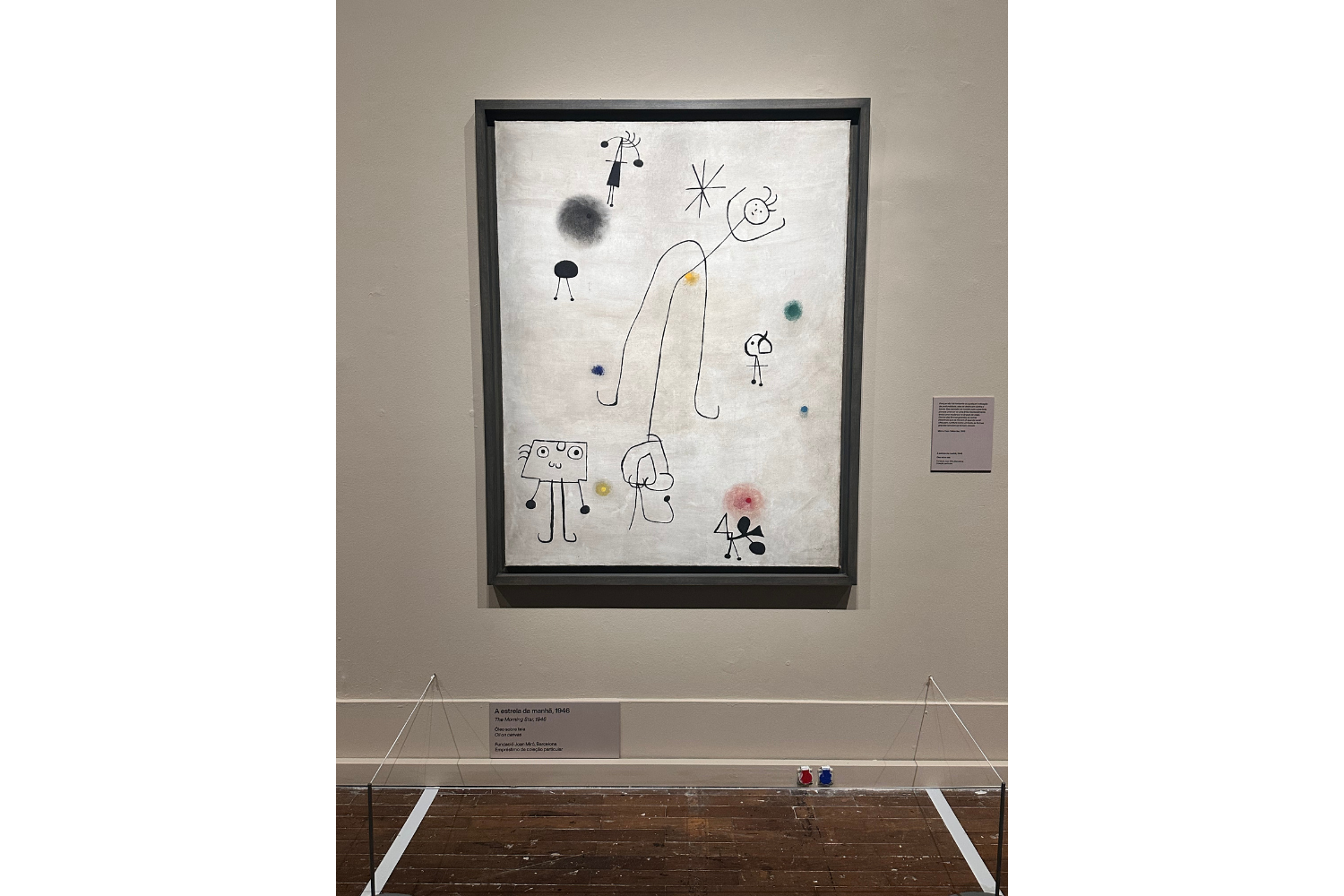
In The Morning Star (1946), one of the works on show, Miró reduces the visible world to a constellation of signs, lines and forms suspended against a deep field of colour. The star becomes less an object to be represented than a sign within a visual vocabulary that remains open to interpretation. Here, simplification does not mean abstraction for its own sake. Instead, Miró transforms recognisable elements into a language capable of suggesting more than it describes. The work offers a particularly clear example of how his signs gradually acquired an autonomy of their own, becoming at once deeply personal and open to different ways of being read.
Among the media on show are tapestries, which reveal how his investigation moved beyond canvas and paper to occupy radically different surfaces, dimensions and textures. One work in the exhibition stands apart. In 1971, Miró produced fifteen lithographs accompanied by a long, sinuous poem inspired by Guillaume Apollinaire’s calligrammes, published in Paris by Louis Broder and printed at the Mourlot workshops, under the title “El lagarto de plumas doradas”. The series remained, at the time, confined to paper. It was only in the 1980s, after the artist’s death, that his widow, daughter and grandchildren decided to transform the series into a tapestry as a posthumous tribute, or, in the words of his grandson, “an integral part of the master’s artistic legacy.” To carry out the transposition, they turned to Josep Royo, the Catalan weaver with whom Miró had collaborated during his lifetime on monumental pieces.
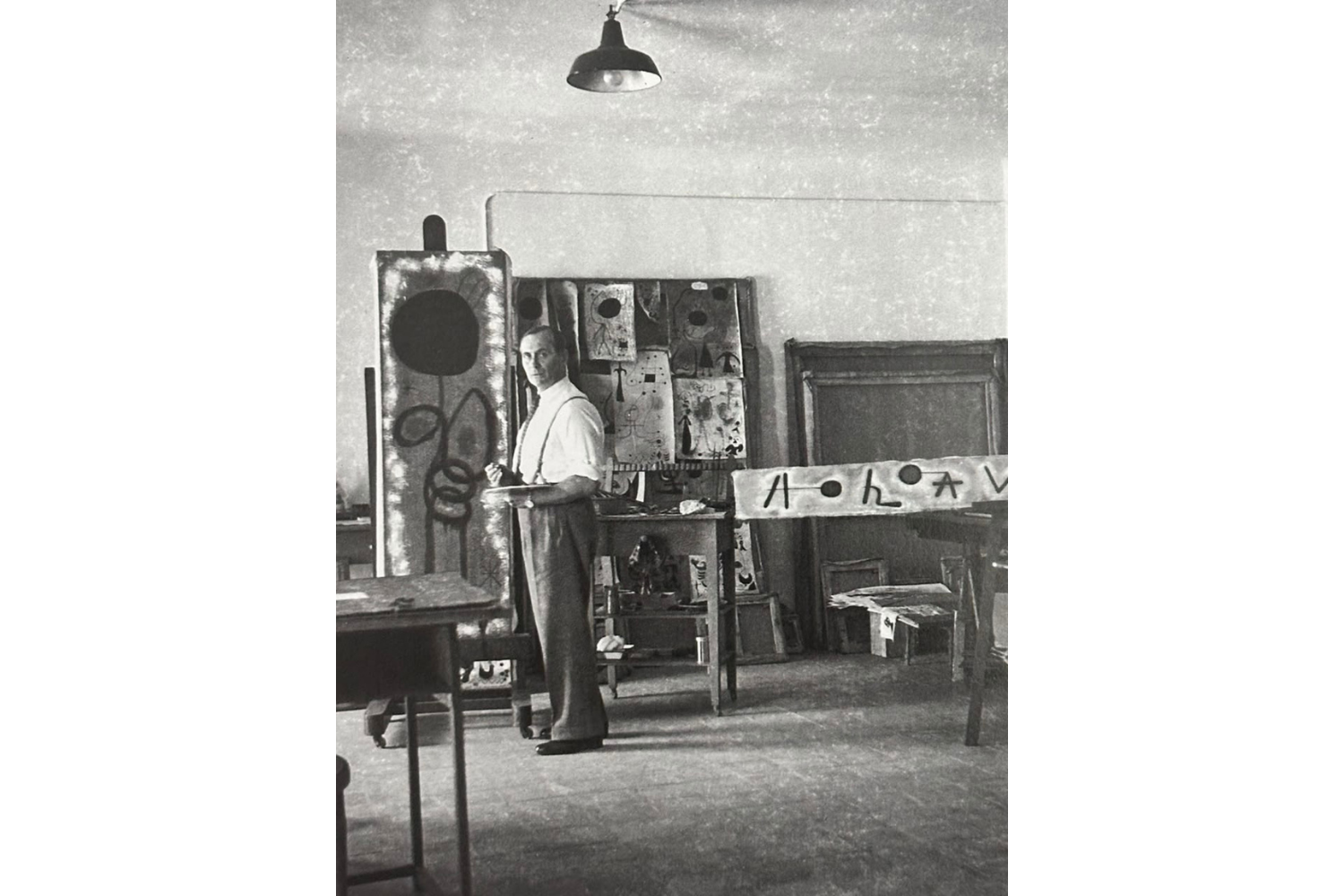
The exhibition also offers a more intimate encounter with Miró through photographs taken by his friend Joaquim Gomis. A businessman, collector and the first president of the Fundació Joan Miró, Gomis maintained a friendship with the artist that lasted more than fifty years. Over the decades, he photographed Miró in his studio, documenting his creative process as well as the found objects to which the artist attached such importance. The photographs on show therefore carry a quality that goes beyond the documentary. They reveal Miró in his working environment, surrounded by the objects that fed his imagination, and offer a rare glimpse of the person behind the artist.
Miró: Mestre das Formas is on at MAB FAAP until 12 October, as the museum marks its 65th anniversary. The breadth of the works on show allows you to follow not only the evolution of an artist, but the construction of a visual system all his own: a language that begins with the recognisable world and transforms it into line, form, colour and sign. Its signs are deeply personal, yet their simplicity gives them an unusual communicative power, allowing them to cross linguistic and cultural boundaries without depending on a single fixed meaning. Miró simplifies forms, but never the way we see. That is where the force of his work lies: the less he describes, the more he invites us to see.
Marilia Lopes for London Art Walk
August 2026